Wi-Fi Myth Series - Myth #18: 6 GHz Means RF Design Doesn’t Matter Anymore
More spectrum, fewer headaches? If only RF engineering were that simple.
There's something undeniably exciting about 6 GHz Wi-Fi... after years of squeezing increasingly demanding networks into the crowded 2.4 GHz and 5 GHz bands, engineers finally have access to a substantial amount of additional spectrum.
More channels. Less legacy interference. Wider channel options. It's almost enough to make a Wi-Fi engineer believe that life is about to get easier!
Well, almost... because somewhere between the marketing presentations and the real-world deployment, a dangerous assumption has emerged: with all that extra spectrum, careful RF design isn't nearly as important anymore.
Unfortunately, nobody informed the laws of physics.
More Spectrum Doesn't Mean Unlimited Capacity
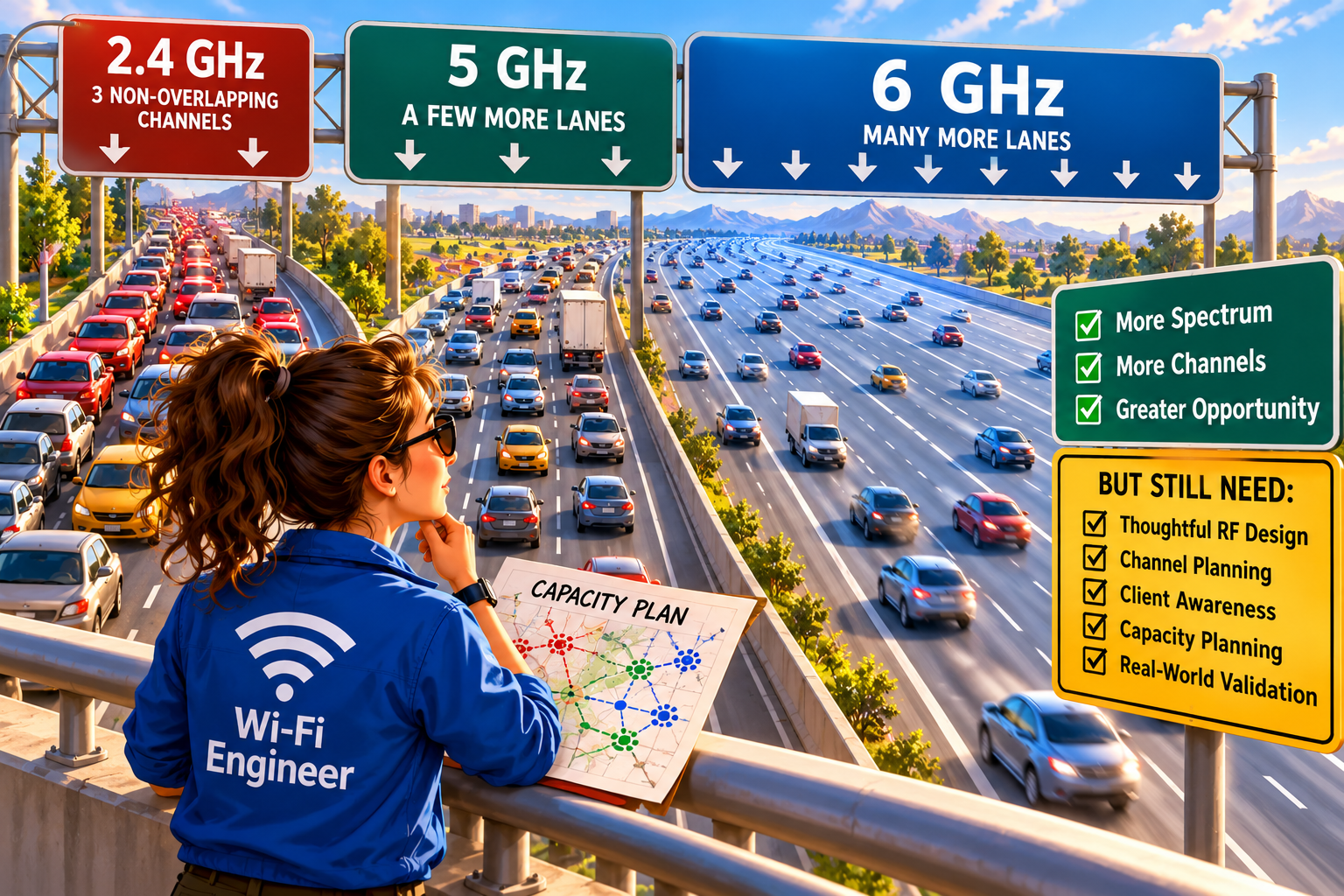
Depending on the regulatory domain, 6 GHz can provide up to 1,200 MHz of additional spectrum. In the United States, that means 59 twenty-megahertz channels, compared with the far more constrained channel choices available in 2.4 GHz.
This is a significant improvement, but spectrum availability and network capacity aren't interchangeable.
A network's actual capacity still depends on
- channel utilization,
- airtime efficiency,
- client distribution,
- contention, and
- application requirements.
Deploy enough APs without considering their relationships and even a relatively spacious band can become congested.
Imagine more lanes on a highway. That would be wonderful but, unfortunately, they don't prevent traffic jams when everyone decides to use the same exit!
Physics Still Has the Final Say
One of the most important characteristics of 6 GHz is its propagation behavior.
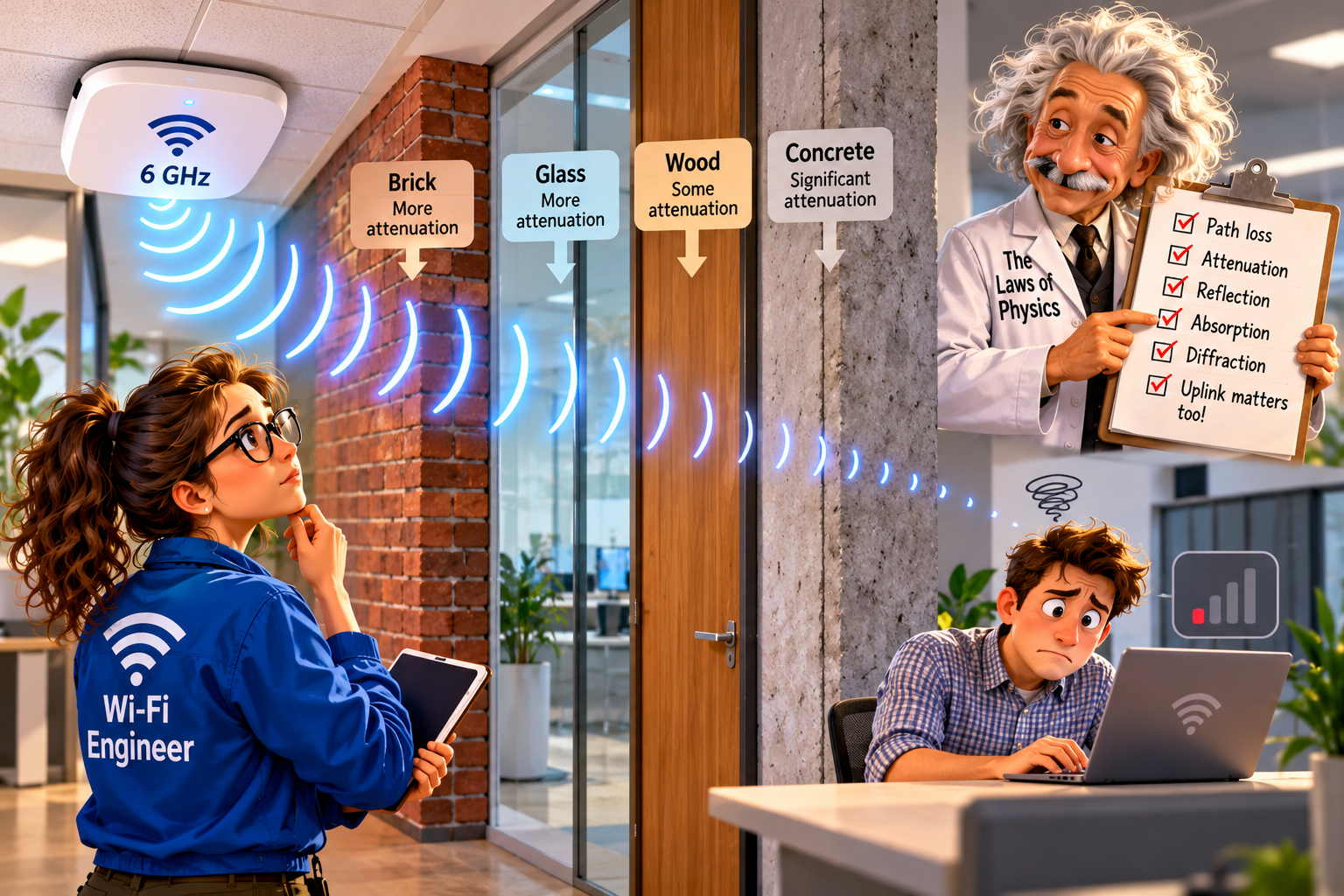
At equivalent distances, and under comparable conditions, free-space path loss is slightly higher at 6 GHz than at 5 GHz. The difference isn't enormous, but it matters when designing coverage boundaries.
Building materials introduce additional complications. Walls, glass, furniture, and other obstructions can attenuate 6 GHz signals differently from lower-frequency transmissions. Some materials create substantial losses, making assumptions based on existing 5 GHz coverage unreliable.
And, remember, reliable connectivity requires successful communication in both directions. An AP might transmit beautifully across a room, but that doesn't guarantee a battery-powered client can respond with comparable reliability.
The uplink hasn't magically become more powerful just because the spectrum is newer.
Wider Channels Aren't Automatically Better
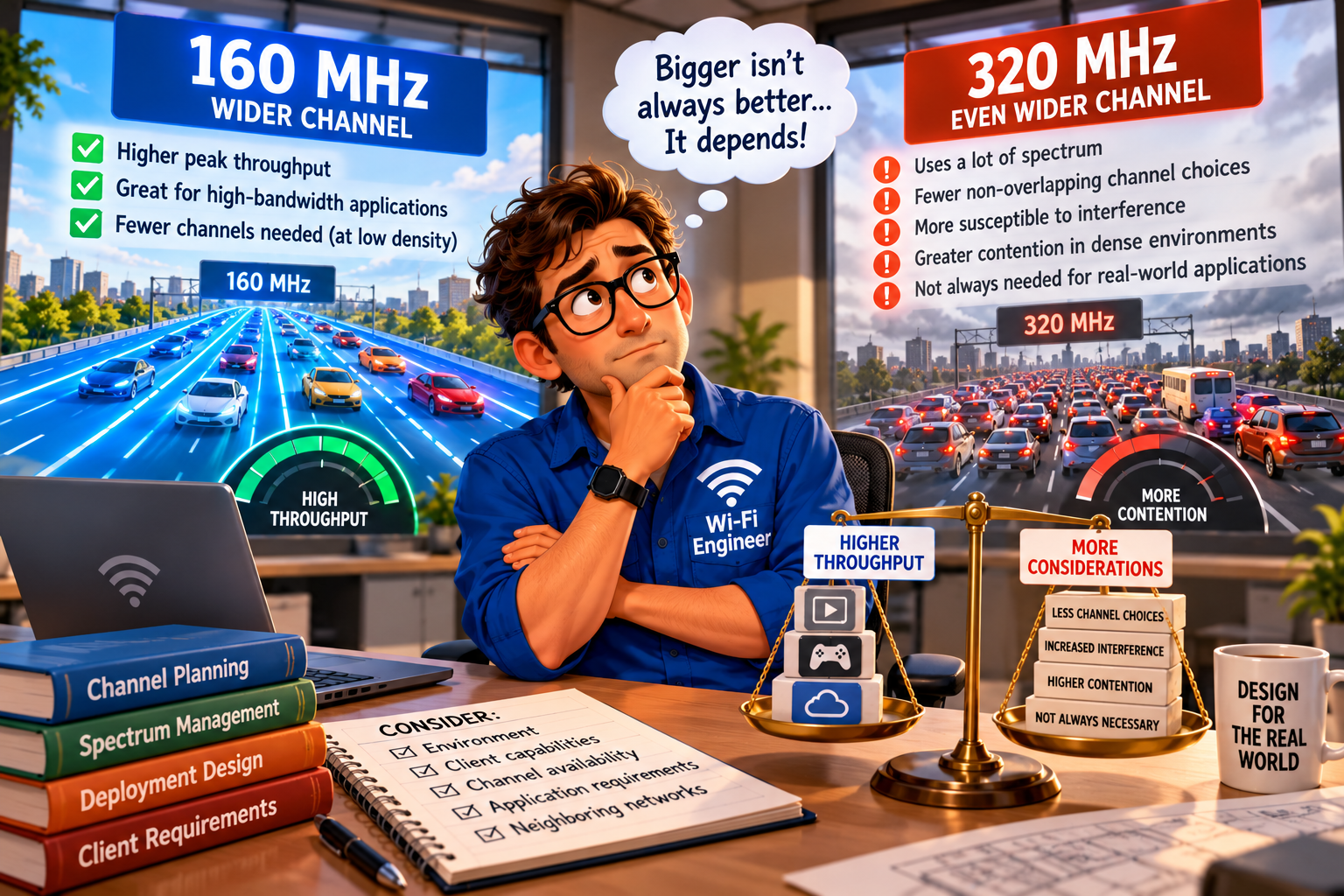
One of 6 GHz's biggest attractions is the availability of wider channels, including 160 MHz and, with Wi-Fi 7, 320 MHz where regulations and equipment permit: wonderful for throughput demonstrations, but not necessarily wonderful for every enterprise deployment.
Wider channels consume more spectrum, reduce the number of non-overlapping channel choices, and can increase contention when neighboring cells overlap. They also don't automatically improve performance for applications that need modest bandwidth but predictable latency.
A well-designed network using narrower channels may deliver a better overall user experience than one chasing impressive peak throughput figures. Sometimes, restraint is the most sophisticated design decision.
Client Capabilities Still Dictate Reality
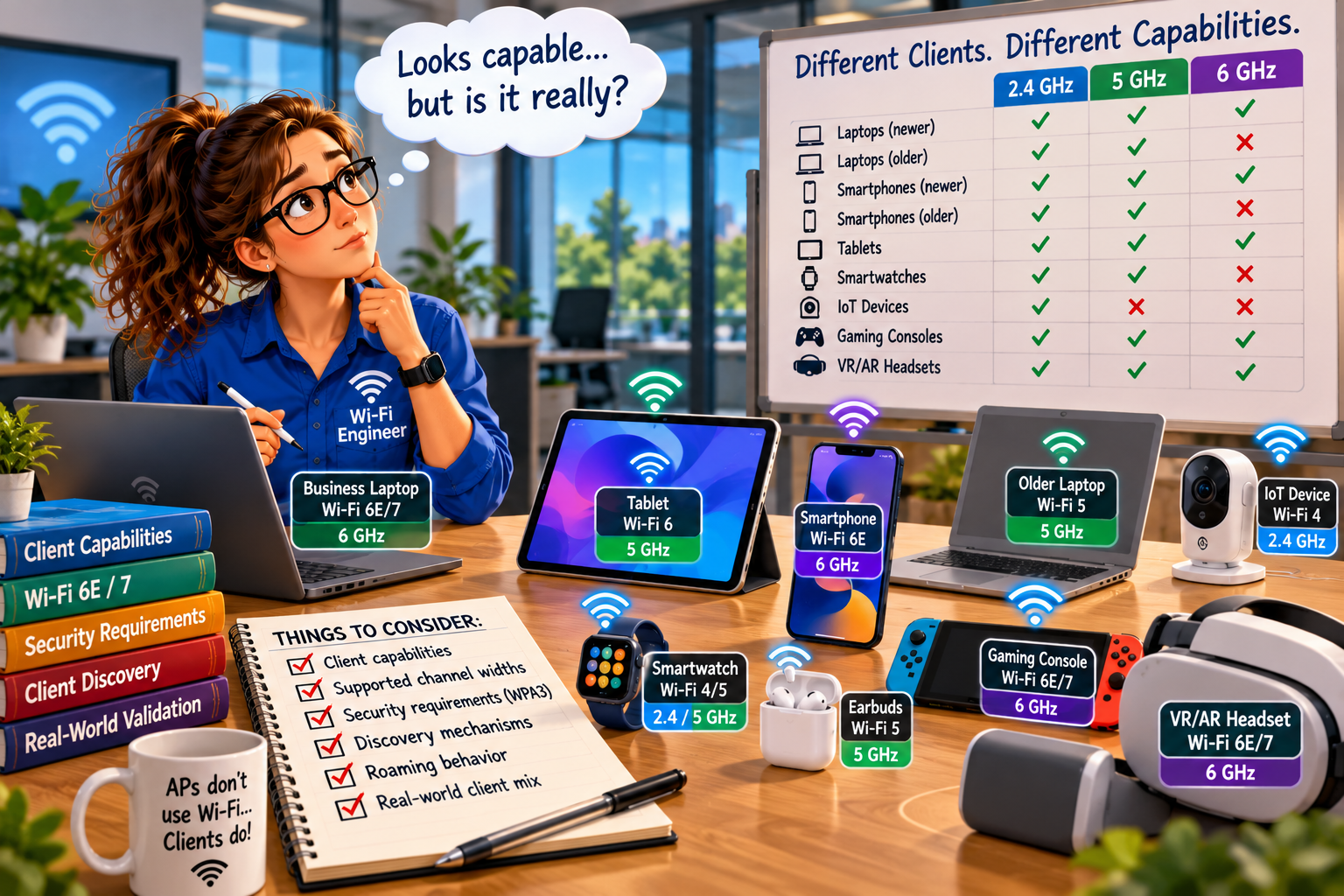
It's easy to get excited about 6 GHz-capable infrastructure. Unfortunately, APs don't use Wi-Fi networks. Clients do.
Client capabilities vary considerably. Some devices support Wi-Fi 6E, others Wi-Fi 7, and many remain limited to 2.4 GHz and 5 GHz. Supported channel widths, transmit power, antenna configurations, and roaming behavior also differ.
Even discovering a 6 GHz network introduces considerations: Reduced Neighbor Reports, Preferred Scanning Channels, and other discovery mechanisms help capable clients locate networks efficiently.
Security requirements matter, too: WPA3 or Enhanced Open requirements mean existing security configurations may need reconsideration.
Deploying 6 GHz without understanding the client population is rather like building a beautiful new freeway without checking whether anyone owns a vehicle capable of using it.

Channel Planning Hasn't Gone on Holiday
More available channels certainly make frequency planning easier in many environments, but "easier" doesn't mean unnecessary.
Regulatory requirements, permitted power levels, and deployment environments influence channel selection.
In the United States, Low Power Indoor operation and Standard Power operation have different constraints, with Standard Power APs requiring Automated Frequency Coordination. These distinctions affect practical network design.
Automatic channel selection can help, but it can't replace understanding neighboring cells, interference sources, expected client density, and application behavior.
And, if you think an automatically generated channel plan guarantees optimal RF performance, you probably might want to revisit Myth #16: the controller would, undoubtedly, have an opinion!
Capacity Design Still Starts With People
Perhaps the biggest mistake is in assuming that additional spectrum eliminates the need for capacity planning. In short, it doesn't.
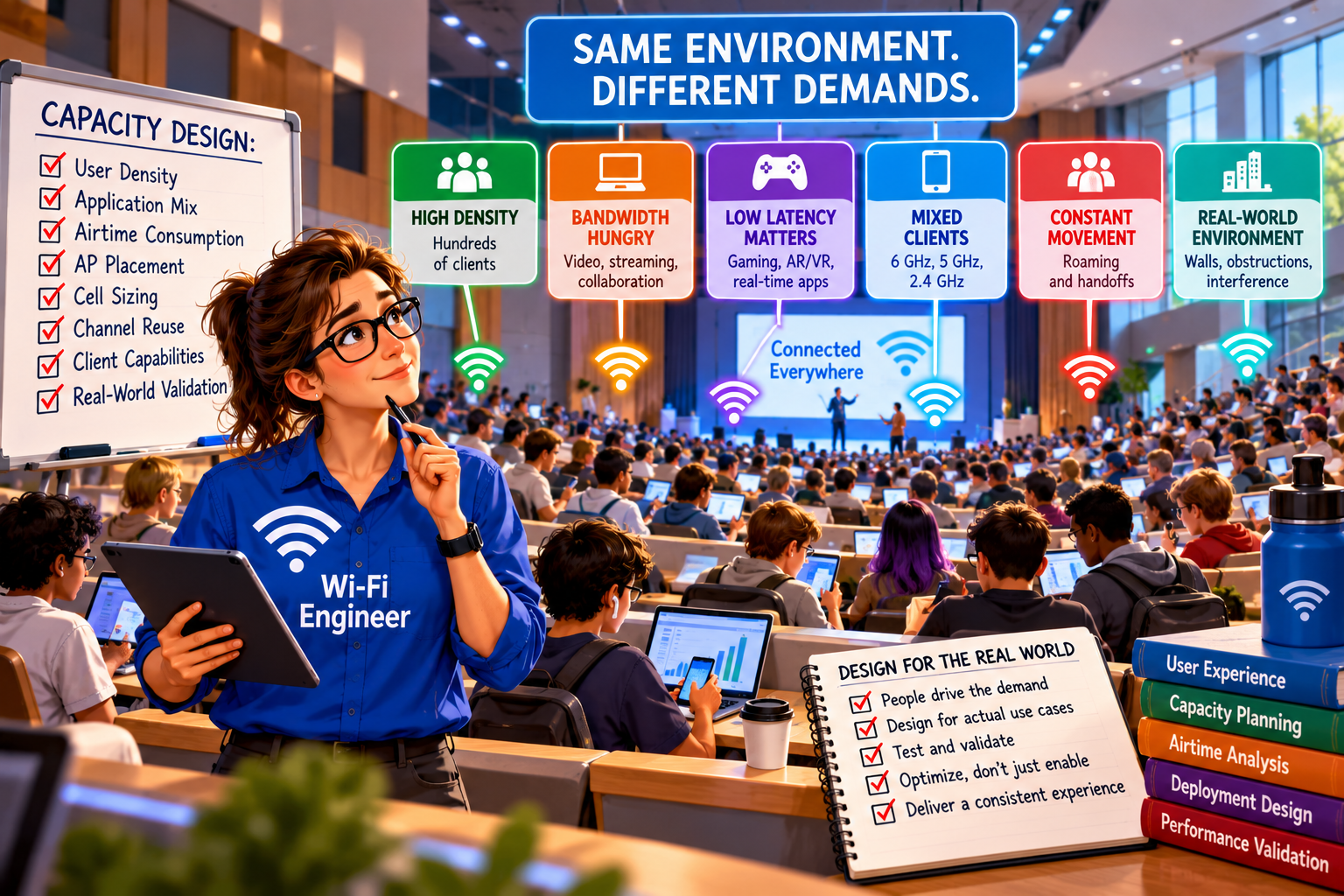
Imagine a lecture hall containing hundreds of connected devices. This presents different challenges from a quiet office with a handful of laptops.
Engineers must still consider simultaneous users, traffic patterns, application requirements, airtime consumption, and device capabilities.
AP placement, cell sizing, and channel reuse remain fundamental and, because 6 GHz coverage may differ from existing bands, simply enabling another radio on every AP doesn't guarantee an optimal deployment.
Sometimes, the best solution involves repositioning APs, adjusting transmit power, or redesigning cell boundaries. That's engineering, not simply configuration.
Busting the Myth
Myth: 6 GHz Means RF Design Doesn’t Matter Anymore
6 GHz is a tremendous advancement for Wi-Fi: additional spectrum creates opportunities for cleaner channels, greater capacity, and improved performance, however, it doesn't eliminate propagation loss, attenuation, contention, client limitations, or poor design decisions. If anything, 6 GHz gives experienced engineers another powerful tool that demands thoughtful implementation.
The fundamentals remain unchanged: understand the environment, understand the clients, design for actual requirements, and validate performance.
More spectrum gives us more possibilities - and good RF design turns those possibilities into reliable Wi-Fi... and, despite what the marketing department might suggest, physics still gets the final vote!
Myth = Busted!
***Helpful note:
if you want to see the images in better perspective, right-click on the picture, and select
Open Image in New Tab***
===
===
Learn More
If you want to learn more about our instructor-led IT training options, visit our training portfolio page here
===
#ITCareers #Certification #Networking #NetworkDesign #CareerDevelopment #ProfessionalDevelopment
===
About NC-Expert
NC-Expert is a privately-held California corporation and is well established within the Wireless, Network Design, Security, and CyberSecurity industry certification training, courseware development, and consulting markets.
NC-Expert has won numerous private contracts with Fortune level companies around the world. These customers have depended on NC-Expert to train, advise, and mentor their staff.
So remember, if you are looking for the best IT training just call us at (855) 941-2121 or contact us
NC-Expert Blog