Wi-Fi Myth Series - Myth #19: AI Will Replace Wi-Fi Engineers?
At last!! This is the long-anticipated blog which was presented at the Wi-Co Conference, in Cleveland Ohio, September 2026...
AI can analyze enormous datasets, identify patterns humans might miss, automate repetitive tasks, recommend configuration changes, predict problems, and increasingly help optimize wireless networks.
So, naturally, the Wi-Fi engineer is doomed. Except… not quite.
AI is already changing wireless networking, and its influence will only grow:
- Network platforms are becoming increasingly capable of turning telemetry into recommendations and, in some cases, taking automated action.
- Tasks that once involved staring at dashboards, correlating logs, comparing historical data, and drinking increasingly questionable quantities of coffee can now be accelerated dramatically.
But there is an important distinction between analyzing a network and engineering one.
AI can tell us a great deal about what is happening. The harder questions are often why it is happening, whether it actually matters, and what should be done about it.
And those questions require
context.
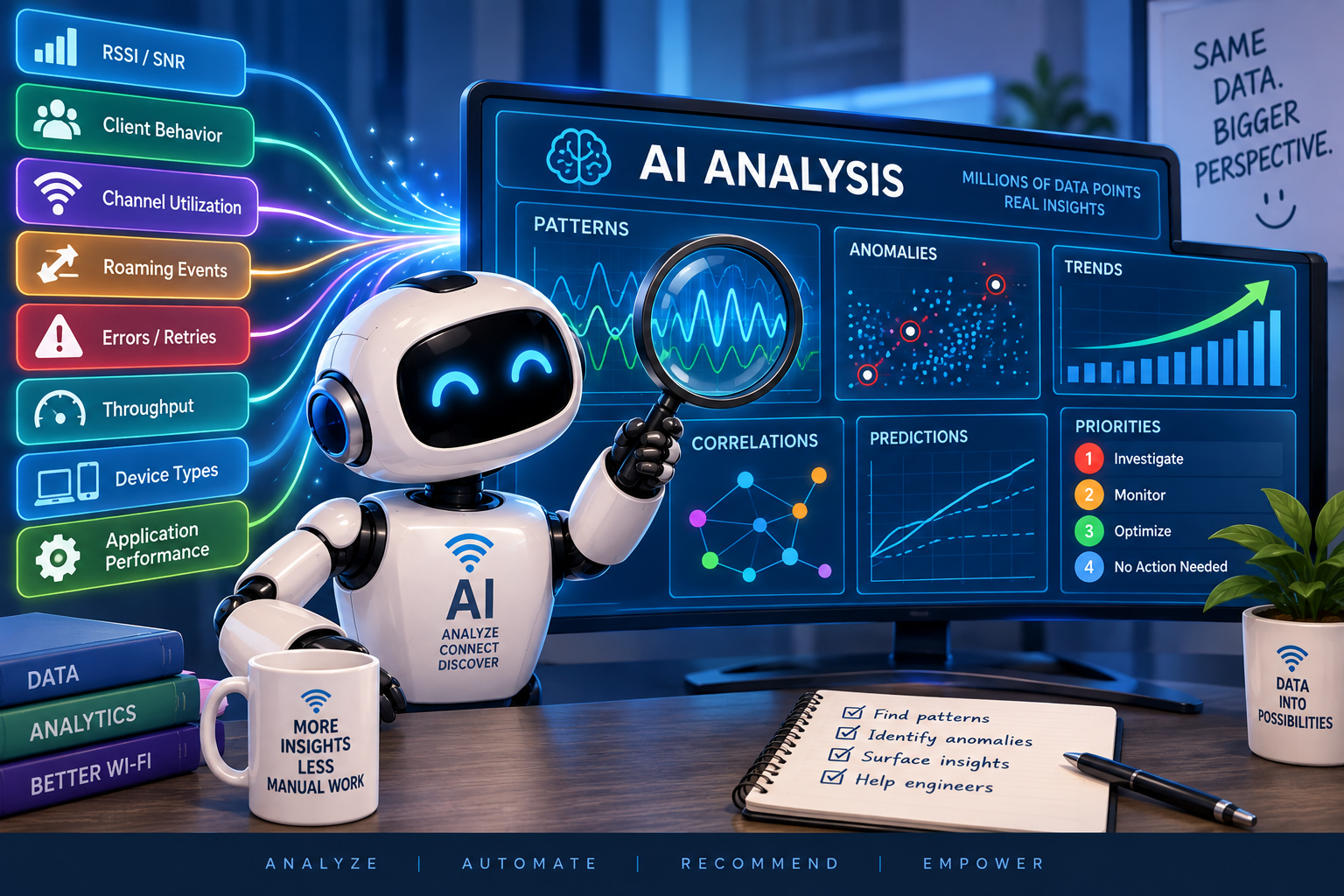
AI is Very Good at Seeing Patterns
Modern Wi-Fi environments generate extraordinary amounts of information:
- RSSI,
- SNR,
- retries,
- channel utilization,
- roaming events,
- association failures,
- authentication latency,
- throughput,
- airtime consumption,
- client capabilities,
- application performance,
...and more.
Humans cannot continuously evaluate every data point across thousands of clients and hundreds (or thousands) of APs. AI can.
AI can:
- Identify unusual behavior,
- correlate events,
- establish baselines,
- detect anomalies,
- prioritize likely causes, and
- surface patterns that might otherwise disappear into a sea of telemetry.
That is enormously valuable.
Instead of an engineer spending hours looking for the proverbial needle in the haystack, AI can effectively say, “I found three suspicious needles. You might want to look at these.”
That does not make the engineer redundant. It makes the engineer faster.
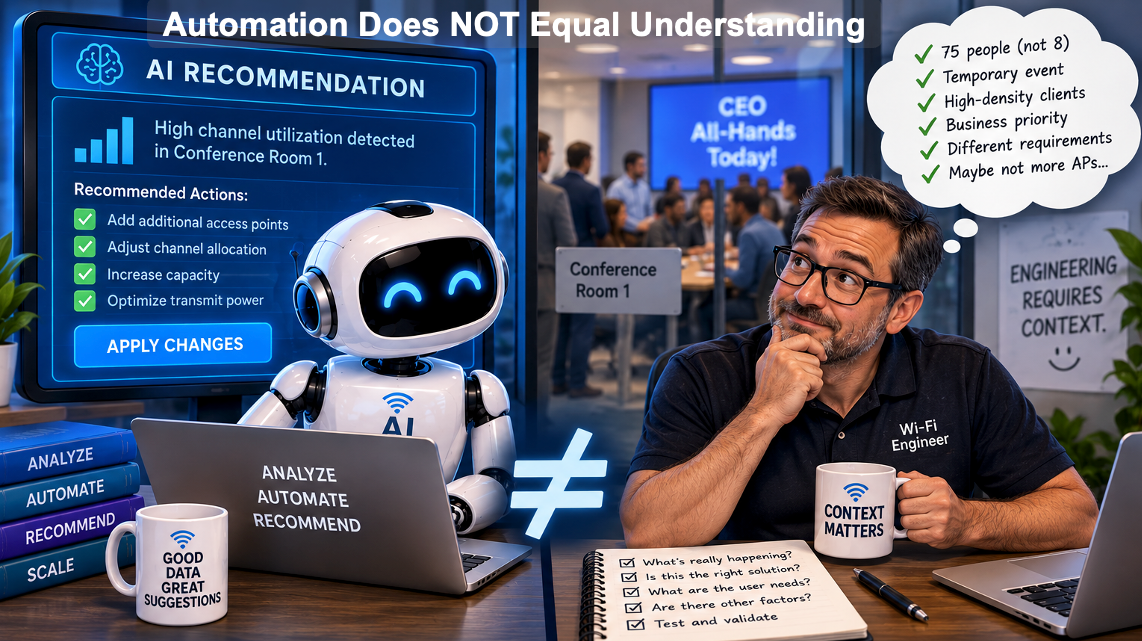
Automation is Not the Same as Understanding
AI can also automate increasingly sophisticated operational decisions.
It might recommend:
- changing channels,
- adjusting transmit power,
- identifying problematic APs,
- flagging poor roaming behavior, or
- suggesting that a particular network condition is responsible for degraded performance.
But remember something we have encountered repeatedly throughout this myth-busting series: a technically reasonable action is not necessarily the correct engineering decision.
Imagine AI detects high channel utilization and recommends adding capacity. That’s a reasonable suggestion. But, what if the conference room experiencing the problem normally seats eight people, but today contains 75 because the CEO is holding an all-hands meeting? What if a warehouse scanner appears to have terrible roaming performance but is actually mounted permanently to a forklift? What if reducing transmit power improves RF metrics but creates problems for a business-critical legacy device?
The data may be completely accurate. The recommendation may even be mathematically sensible. And it can still be wrong for that environment.
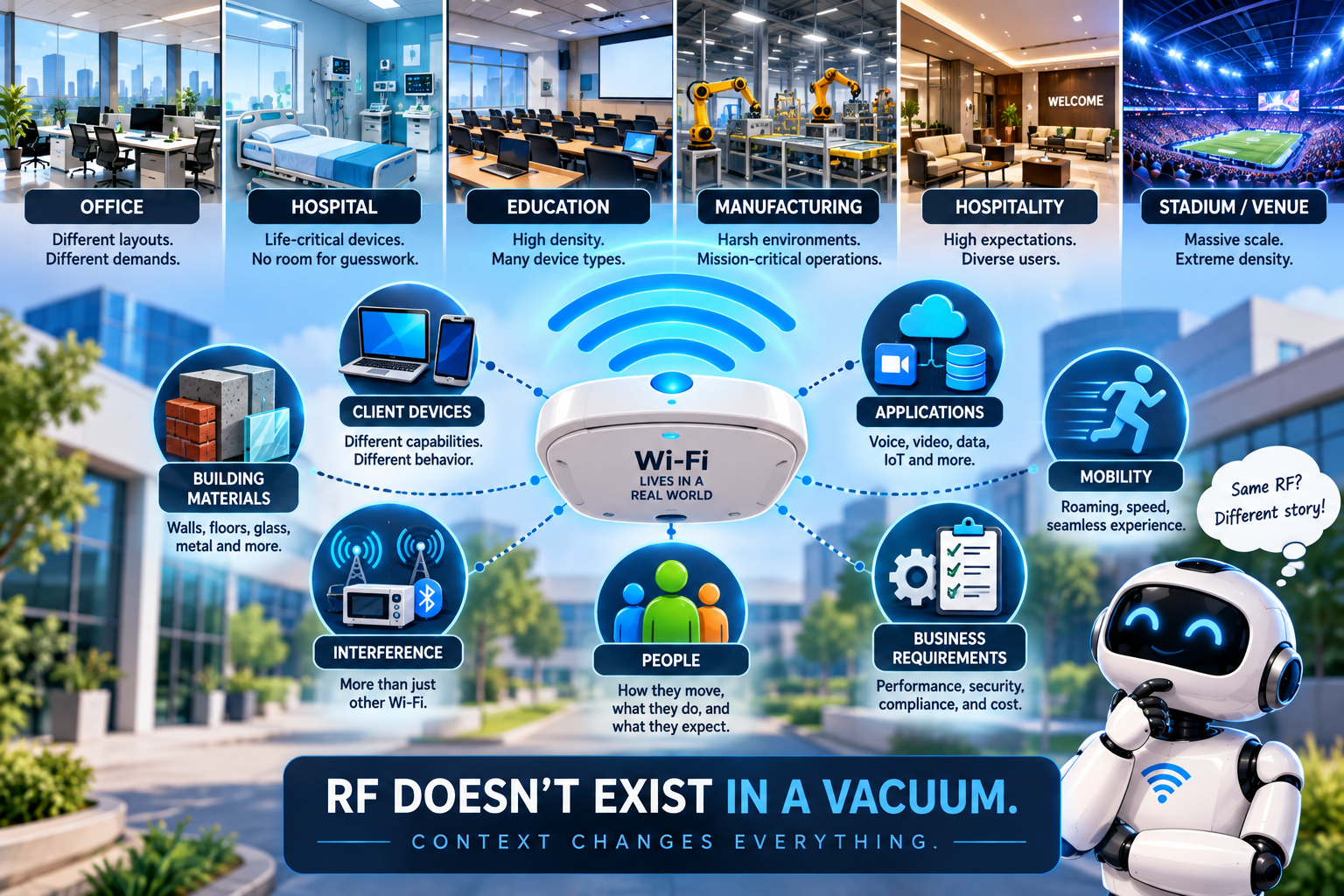
RF Doesn't Exist in a Vacuum
Wi-Fi engineering has always required more than interpreting RF measurements:
- buildings and their materials matter
- client devices matter
- applications matter
- mobility matters
- interference matters
- business operations matter
- and, inconveniently for anyone hoping for a perfectly tidy algorithm, people matter too.
A hospital, warehouse, university, manufacturing facility, hotel, office building, and stadium can all produce similar-looking wireless metrics while having completely different operational requirements.
An AI platform can recognize that a client has poor signal quality. An engineer needs to understand whether that client is a visitor's phone in a stairwell, or a medical device supporting patient care. Those are not equivalent problems. The metric simply provides information.
Context gives that information meaning.
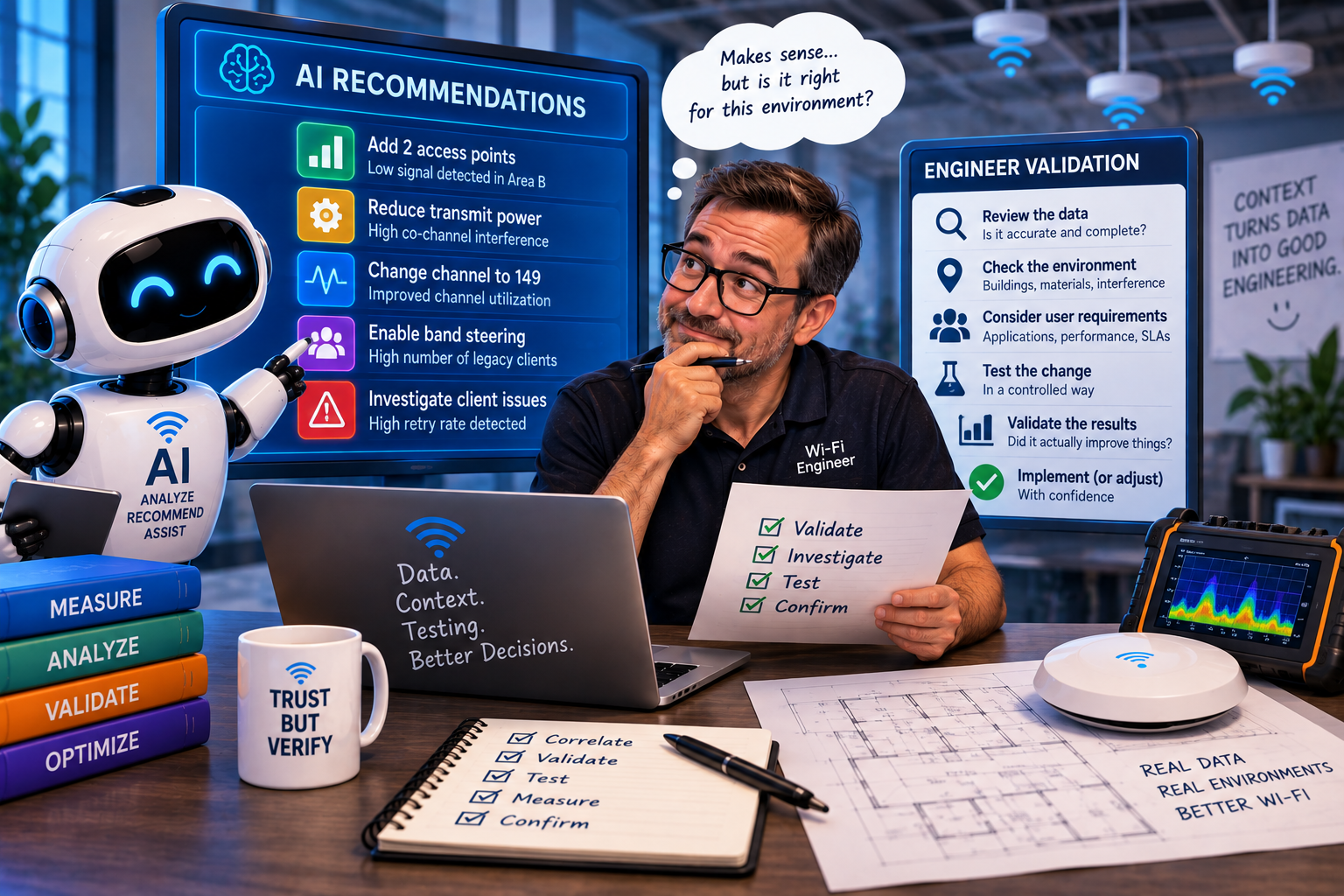
Recommendations Still Need Validation
There is another reason engineers aren't disappearing: AI outputs still need to be validated.
As the old saying goes, “Trust, but verify.”
AI systems work with the information available to them. If the telemetry is incomplete, sensors cannot see a source of interference, client behavior is poorly represented, or assumptions about the environment are incorrect, then the resulting recommendation can be misleading.
A beautifully confident answer based on incomplete information is still an incomplete answer.
Experienced engineers already know this instinctively. We don't accept a dashboard simply because it has attractive graphs and a reassuring green checkmark.
We investigate.
We correlate.
We test.
We measure.
And occasionally we discover that the network's supposedly mysterious RF problem is actually something entirely different.
AI doesn't eliminate that engineering process. It gives us another extremely powerful participant in it.
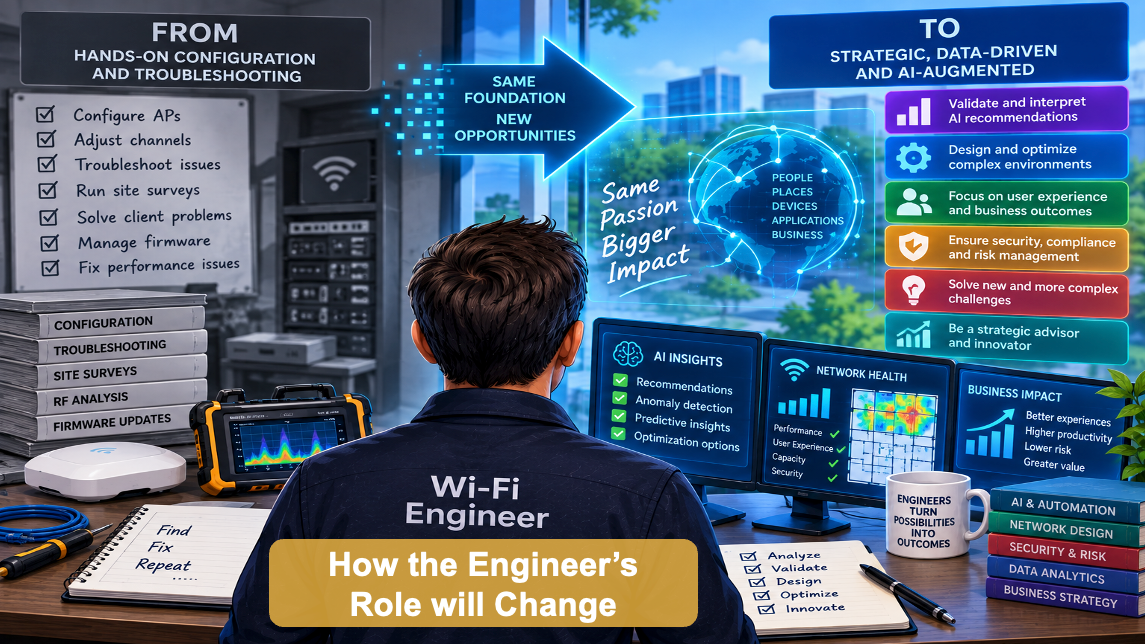
The Engineer's Role Will Change
This is where the AI discussion becomes much more interesting.
The real question isn't, “Will AI replace Wi-Fi engineers?” it is, “What will Wi-Fi engineers be able to accomplish when AI handles more of the analysis and repetitive operational work?”
Engineers may spend less time manually combing through telemetry and more time validating recommendations, investigating complex problems, designing networks, defining requirements, evaluating user experience, and making higher-level engineering decisions.
That means the valuable skills begin moving upward...
- Knowing which button to click becomes less important but understanding RF fundamentals becomes more important.
- Knowing how to interpret evidence becomes more important but understanding client behavior becomes more important.
- Knowing when automation is making the wrong decision becomes much more important.
- And perhaps, most importantly, engineers still need to understand what the network is actually supposed to accomplish.
AI can optimize toward a target, but someone has to define the right target.
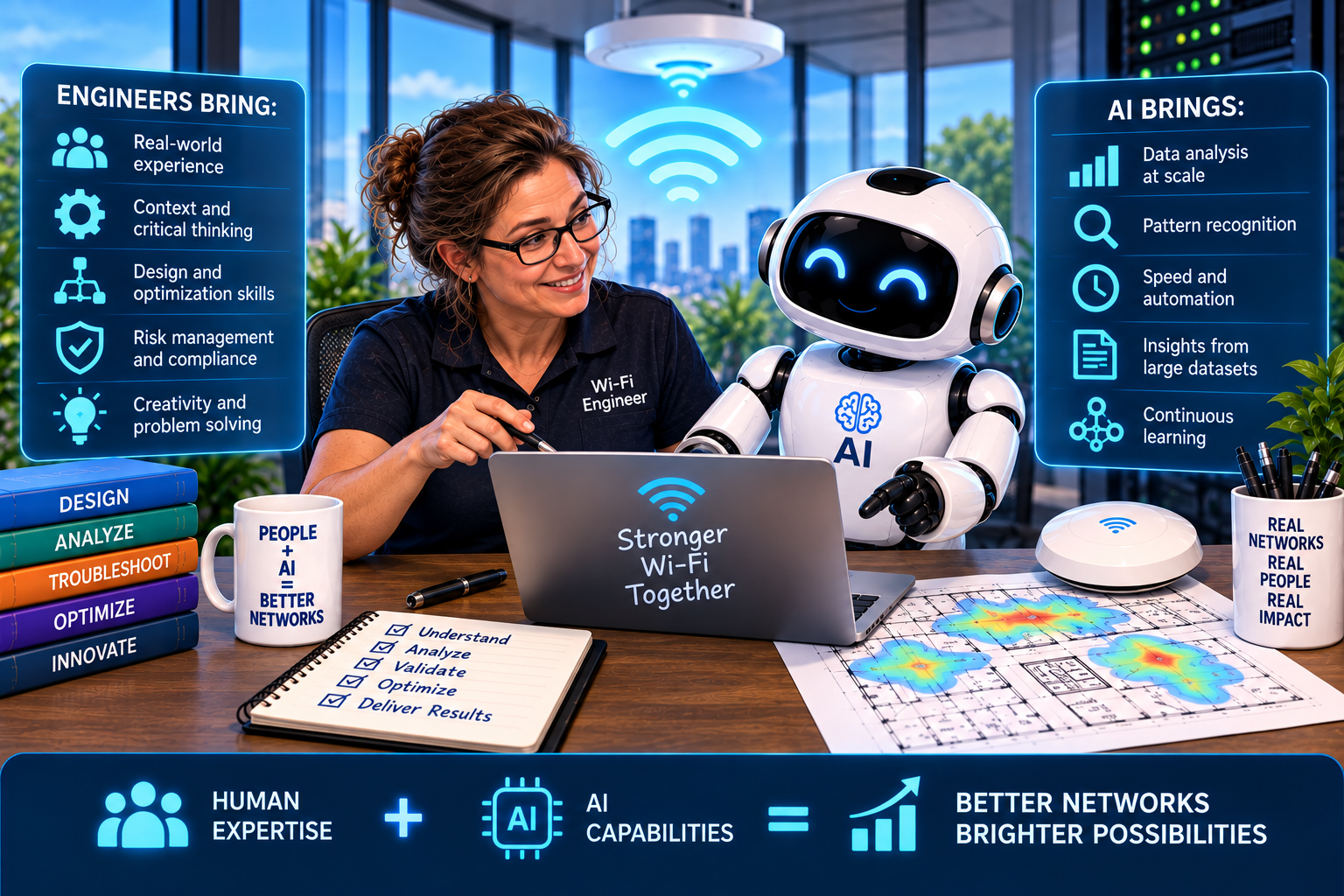
AI Needs Wi-Fi Engineers
Perhaps we have been asking the question backwards: AI isn't simply a potential replacement for Wi-Fi engineers. Properly used, it is an extraordinarily capable tool for Wi-Fi engineers.
It can process more telemetry than we ever could, manually. It can identify correlations faster. It can automate routine work. It can help us investigate problems and recommend possible solutions.
But RF engineering still requires context, validation, judgment, and an understanding of user and business requirements.
Those aren't inconvenient limitations waiting for the next software release to eliminate, they are fundamental parts of engineering.
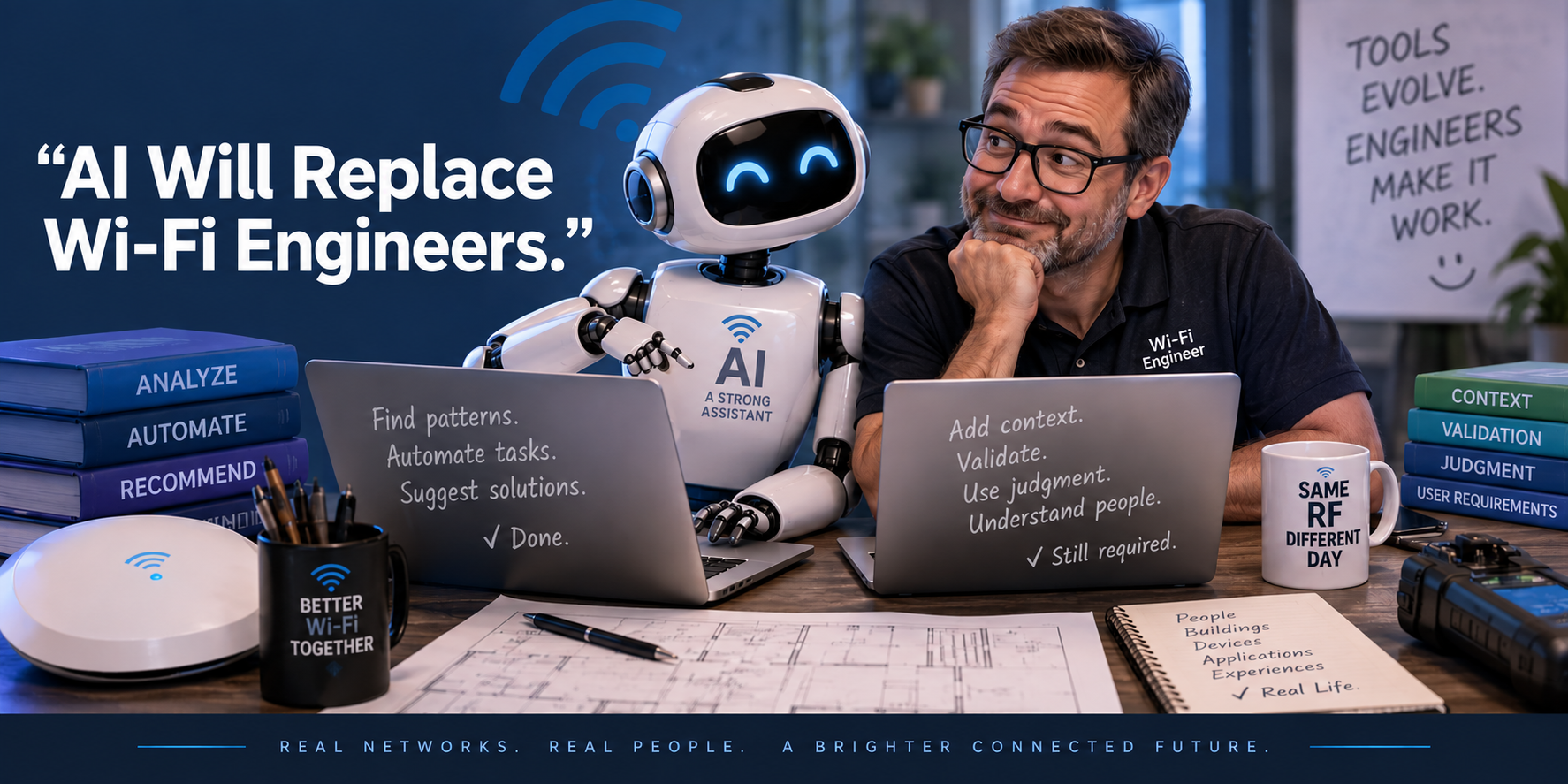
Busting the Myth
Myth: AI Will Replace Wi-Fi Engineers!
AI absolutely will change Wi-Fi engineering:
- Some tasks will disappear.
- Others will become automated.
- Troubleshooting will become faster.
- Network platforms will become increasingly proactive, and engineers who understand how to work effectively with AI will have an enormous advantage.
But replacing repetitive work is not the same thing as replacing engineering.
The future Wi-Fi engineer probably won't compete against AI. The engineer will use AI to analyze more, automate more, investigate faster, and make better-informed decisions ~ while providing the context, validation, judgment, RF expertise, and understanding of human requirements, that turn data into good engineering.
So perhaps the real threat isn't that AI will replace Wi-Fi engineers. It is that Wi-Fi engineers who know how to use AI effectively will have a significant advantage over those who don't.
And that is a very different conversation. :)
Myth = Busted!
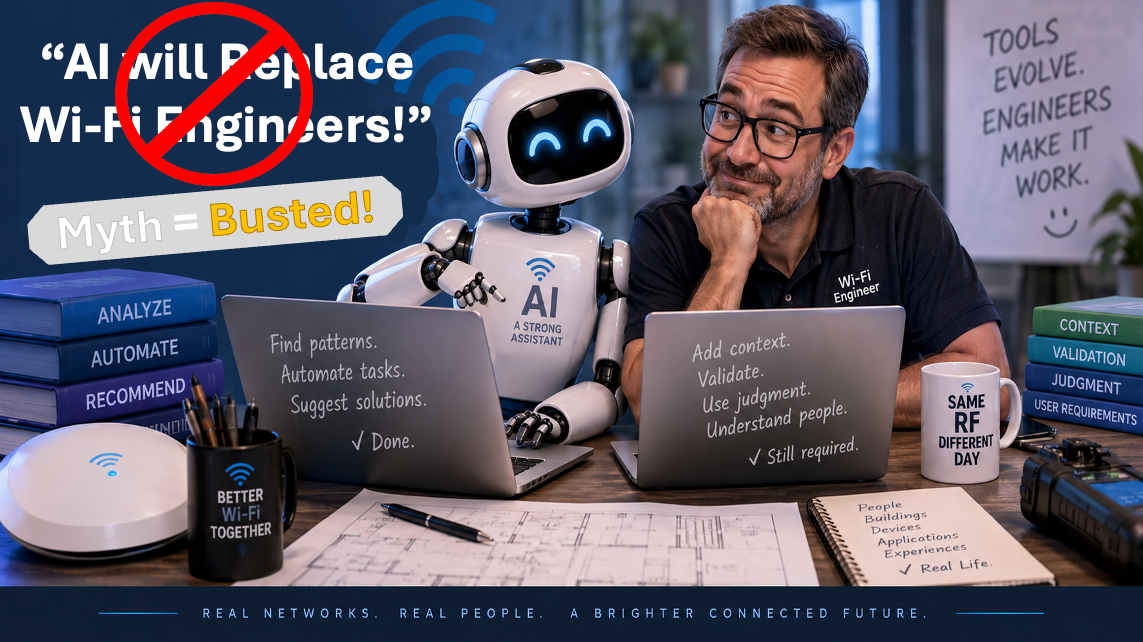
***Helpful note: if you want to see the images in better perspective, right-click on the picture, and select Open Image in New Tab***
===
===
Learn More
If you want to learn more about our instructor-led IT training options, visit our training portfolio page here
===
#ITCareers #Certification #Networking #NetworkDesign #CareerDevelopment #ProfessionalDevelopment
===
About NC-Expert
NC-Expert is a privately-held California corporation and is well established within the Wireless, Network Design, Security, and CyberSecurity industry certification training, courseware development, and consulting markets.
NC-Expert has won numerous private contracts with Fortune level companies around the world. These customers have depended on NC-Expert to train, advise, and mentor their staff.
So remember, if you are looking for the best IT training just call us at (855) 941-2121 or contact us
NC-Expert Blog