IT Certification Exams: the Struggle is Real!
Why Experienced Engineers Sometimes Struggle with Certification Exams
If you’ve spent years working in IT, there’s a good chance you’ve had this thought at some point: "I do this stuff every day. Surely the certification exam will be easy?" Then reality arrives.
You sit the exam. The questions seem strangely worded. Topics appear that you rarely touch in your day job. You find yourself second-guessing answers you know are correct in the real world. Before long, confidence starts to evaporate. It’s a surprisingly common experience. In fact, some of the most experienced engineers occasionally struggle with certification exams, not because they lack technical ability, but because experience and exam readiness are two very different things.

Experience Is Practical ~ Exams Are Structured
Most IT professionals build knowledge through real-world problem solving. When a network goes down, users can’t connect, or a security alert appears at 2:00 AM, engineers learn by investigating, troubleshooting, and fixing the problem. Over time, they develop deep expertise in the technologies they work with every day. That experience is incredibly valuable.
However, certification exams are designed differently. They are not measuring only whether you can perform a task. They are also measuring whether you understand concepts, terminology, best practices, standards, methodologies, and vendor recommendations across a broad range of topics.
An engineer may be exceptionally skilled at managing enterprise wireless networks but struggle with exam questions covering technologies they rarely encounter. Likewise, a cybersecurity professional may excel at incident response but find themselves revisiting cryptography concepts they haven’t studied in years.
The issue isn’t competence: the issue is
alignment.

The “Known Unknowns” Problem
One of the biggest surprises for experienced engineers is discovering how much knowledge exists outside their daily responsibilities.
Most jobs require specialization. A network engineer might spend 80% of their time working with switching, routing, and wireless technologies. A security analyst may focus primarily on monitoring and investigations. A systems administrator may live almost entirely within cloud and server environments.
Certification exams don’t care what your job description says. They expect knowledge across the entire certification blueprint. Many candidates only discover their knowledge gaps after beginning exam preparation. This can be frustrating because they genuinely know their field well. Yet, the exam is testing the candidate in areas they simply haven't needed to use recently... or perhaps ever.
Experience Can Create Assumptions
This may sound counterintuitive, but sometimes experience can actually make exam questions harder. Experienced engineers often approach questions from a practical perspective. They think: "What would I do in production?"
Exam writers sometimes have a different objective. They want the answer that aligns with a documented methodology, official best practice, or certification framework.
As a result, highly experienced candidates occasionally overthink questions. They evaluate multiple valid solutions, consider business constraints, or imagine real-world exceptions. Meanwhile, the exam is simply looking for the textbook answer.
Newer candidates often avoid this trap because they have recently studied the material exactly as the certification expects it to be understood.
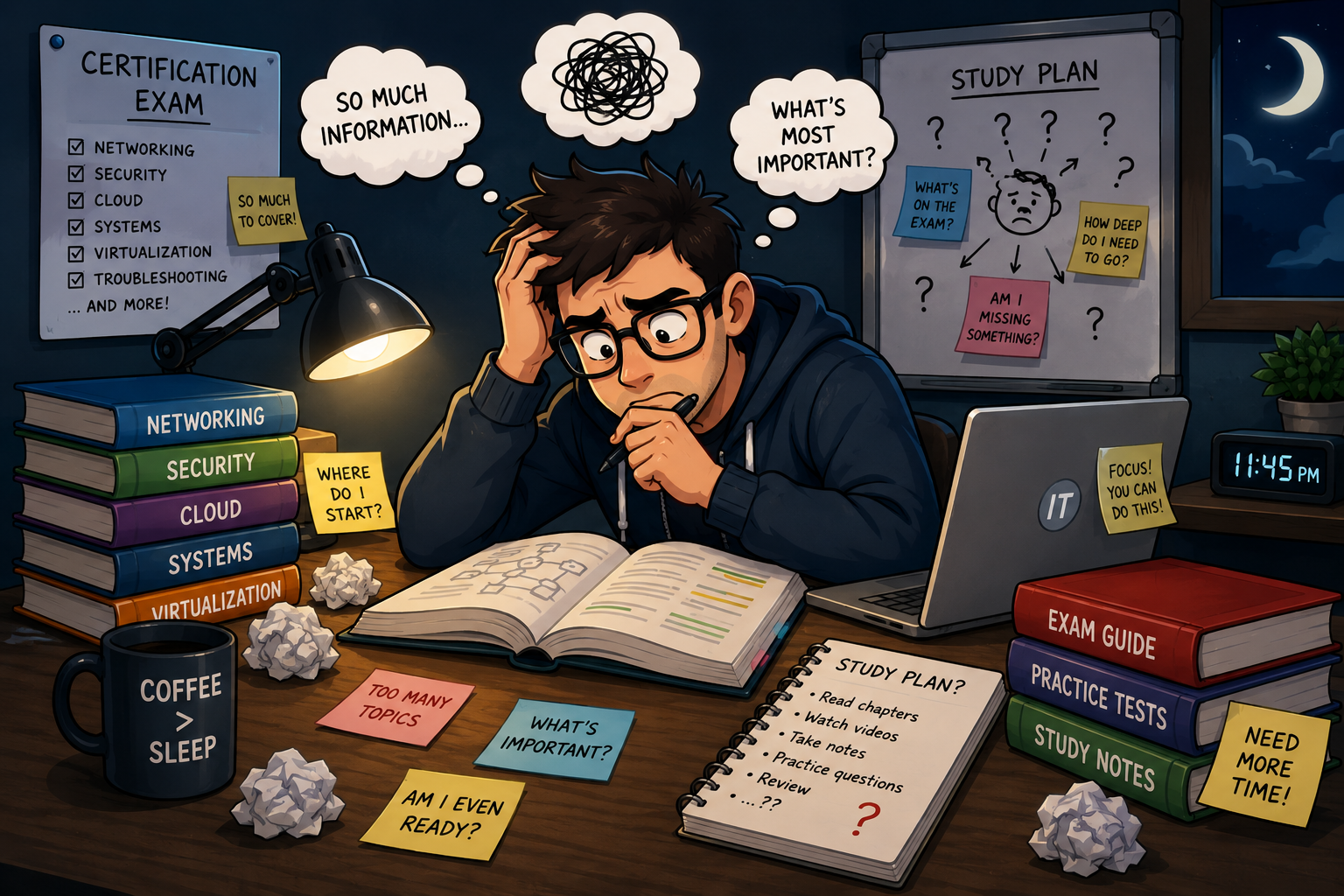
The Challenge of Studying Alone
Many professionals preparing for a career transition decide to self-study. There are obvious advantages. It is flexible, affordable, and can fit around work and family commitments. However, self-study also creates challenges. Without structure, it can be difficult to determine:
· Which topics deserve the most attention?
· What is likely to appear on the exam?
· Which areas represent personal knowledge gaps?
· How deeply each subject needs to be understood.
Many candidates spend weeks reviewing material they already know while overlooking topics that carry significant exam weight. The result is often a lot of effort with less progress than expected.
Why Structured Training Helps
This is where structured instructor-led training can make a significant difference. Good training does more than simply present information: it provides a roadmap.
Instead of guessing what to study, learners follow a structured path aligned to the certification objectives. Complex topics are explained clearly, misconceptions are corrected early, and instructors can highlight areas that frequently cause difficulty.
Perhaps most importantly, experienced instructors understand the difference between operational knowledge and exam knowledge. They can help learners bridge the gap between what they already know and what the certification requires. For experienced engineers, this often accelerates preparation dramatically.
Rather than starting from scratch, they build on existing expertise while filling in the specific knowledge gaps needed for certification success.

A Career Transition Opportunity
For engineers considering a career move: certifications may play an important role.
They can demonstrate commitment, validate knowledge, and help open doors to new opportunities. Whether moving into cybersecurity, networking, cloud technologies, wireless engineering, or management roles, certifications frequently provide valuable credibility. But passing the exam requires more than experience alone.
The most successful candidates usually combine practical expertise with focused preparation and a structured learning approach. That combination turns existing experience into recognized credentials.
Food for Thought
If you've ever struggled with a certification exam despite years of experience, you're certainly not alone. It doesn't mean you're a poor engineer. In many cases, it means you're an experienced engineer who hasn't yet aligned practical knowledge with exam expectations. The good news is that the gap is usually much smaller than it appears.
With the right preparation strategy, clear guidance, and structured learning, experienced professionals often discover that certification success arrives faster than expected. After all, the knowledge is already there: sometimes it simply needs organizing, refining, and pointing in the right direction.
===
===
Learn More
If you want to learn more about our instructor-led IT training options, visit our training portfolio page here
===
#ITCareers #Certification #Networking #CyberSecurity #CareerDevelopment #ProfessionalDevelopment
===
About NC-Expert
NC-Expert is a privately-held California corporation and is well established within the Wireless, Security, and CyberSecurity industry certification training, courseware development, and consulting markets.
NC-Expert has won numerous private contracts with Fortune level companies around the world. These customers have depended on NC-Expert to train, advise, and mentor their staff.
So remember, if you are looking for the best IT training just call us at (855) 941-2121 or contact us
NC-Expert Blog