Wi-Fi Myth Series – Myth #2: Higher Transmit Power Means Better Wi-Fi
If there were a "Wi-Fi Myths Hall of Fame," this one would have its own wing!
At some point in almost every Wi-Fi engineer's career, someone suggests turning up the transmit power to solve a coverage or performance problem. The logic seems sound: if a louder signal reaches farther, surely users will enjoy better Wi-Fi?
Unfortunately, Wi-Fi doesn't work quite that way.
The myth that higher transmit power automatically means better Wi-Fi has survived for decades because it feels intuitive. More power sounds stronger. Stronger sounds better. Yet in real-world Wi-Fi environments, increasing transmit power often creates new problems while solving very few.
Let's explore why...

The "Megaphone" Problem
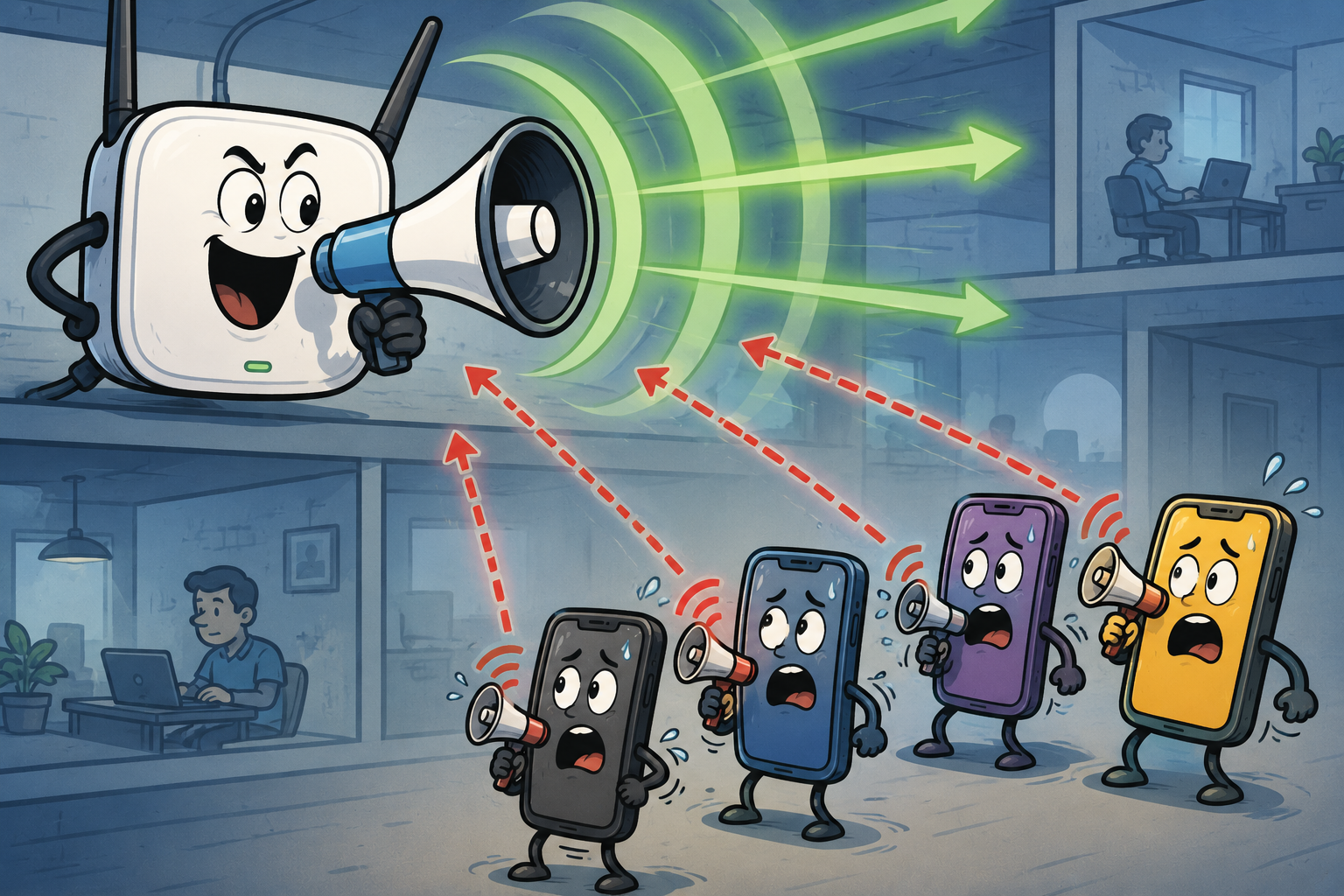
Imagine you're standing in a crowded room trying to have a conversation. If you start shouting, more people can hear you. Great. But can you hear them any better? Probably not.
Wi-Fi works similarly. Communication is a two-way conversation. The AP and the client device must both hear each other clearly. Many engineers focus on the AP's transmit power while forgetting about the other half of the link.
Your access point may be transmitting at 23 dBm, but the smartphone trying to respond may only be capable of transmitting at 15 dBm.
The AP can shout across the building. The phone cannot shout back. This creates an imbalance known as an asymmetric link. The client hears the AP just fine, but the AP struggles to hear the client. The result is often unreliable connectivity, retransmissions, poor throughput, and frustrated users.
The Wi-Fi equivalent of a one-sided phone call is rarely enjoyable.
Coverage Is Not Capacity
Another reason this myth persists is because transmit power can appear to improve coverage. When transmit power increases, signal strength measurements often look better. Coverage maps may show larger cells. Devices may detect the SSID from farther away. Everything appears successful until users actually start using the network.
Coverage and capacity are not the same thing. A larger cell means more clients competing for airtime within the same coverage area. As client density increases, contention increases. More devices wait their turn to transmit, reducing overall efficiency. In effect, you have built a larger traffic jam.
The Wi-Fi network may look impressive on a floor plan while performing poorly in practice.
(For more on Coverage vs Capacity see this earlier
blog )

When Roaming Starts to Misbehave
Certified Wi-Fi engineers have all encountered sticky clients. These are devices that refuse to roam to a closer AP even when a better option is available. High transmit power can make this behavior significantly worse.
When APs are transmitting loudly, clients continue hearing distant APs at acceptable signal levels. As a result, they delay roaming decisions and remain connected longer than they should.
Instead of transitioning smoothly to the nearest AP, clients cling to a distant AP like a traveler refusing to leave a comfortable airport lounge... despite missing three connecting flights! The overall result is reduced throughput, increased retries, and inconsistent user experiences.
So, ironically, turning up power often makes mobility performance worse, rather than better.

More Power Means More Interference
One of Wi-Fi engineering's fundamental truths is that Wi-Fi is interference-limited more often than coverage-limited.
Every time an AP transmits, it occupies airtime.
Increasing transmit power enlarges the area over which that transmission can be heard. While this may sound beneficial, it also increases co-channel interference.
Neighboring APs hear each other more frequently. More devices defer transmission. Channel reuse becomes less efficient. The network spends more time waiting and less time communicating. This is particularly important in modern enterprise environments where AP density is already relatively high.
Adding power, in these instances, is often comparable to adding more cars to an already congested highway and expecting the traffic situation to improve.
Why Lower Power Often Works Better
This is the part that surprises newer engineers: Many well-designed Wi-Fi networks intentionally operate at lower transmit power levels. Why? Because smaller cells provide several advantages:
· Better channel reuse
· Reduced co-channel interference
· More predictable roaming
· Improved capacity
· Better client balance across APs
Rather than creating one giant coverage bubble, modern Wi-Fi design focuses on creating many appropriately sized cells that work together efficiently. This is especially important in Wi-Fi 6 and Wi-Fi 7 environments where capacity, spatial reuse, and airtime efficiency often matter more than maximum coverage distance.
The goal is not to make APs louder. The goal is to make the network smarter.
The Real Objective
Experienced Wi-Fi engineers eventually discover that transmit power is not a performance knob - it is a design parameter.
The objective isn't to maximize power - the objective is to achieve balance:
· Balanced coverage
· Balanced uplink and downlink communication
· Balanced roaming behavior
· Balanced channel reuse
When those elements align, users experience reliable, high-performing Wi-Fi regardless of whether the AP is transmitting at maximum power. In fact, some of the best-performing wireless networks operate well below their maximum transmit capabilities.
Important Concepts
"Higher transmit power means better Wi-Fi." This sounds reasonable until you examine how Wi-Fi actually functions.
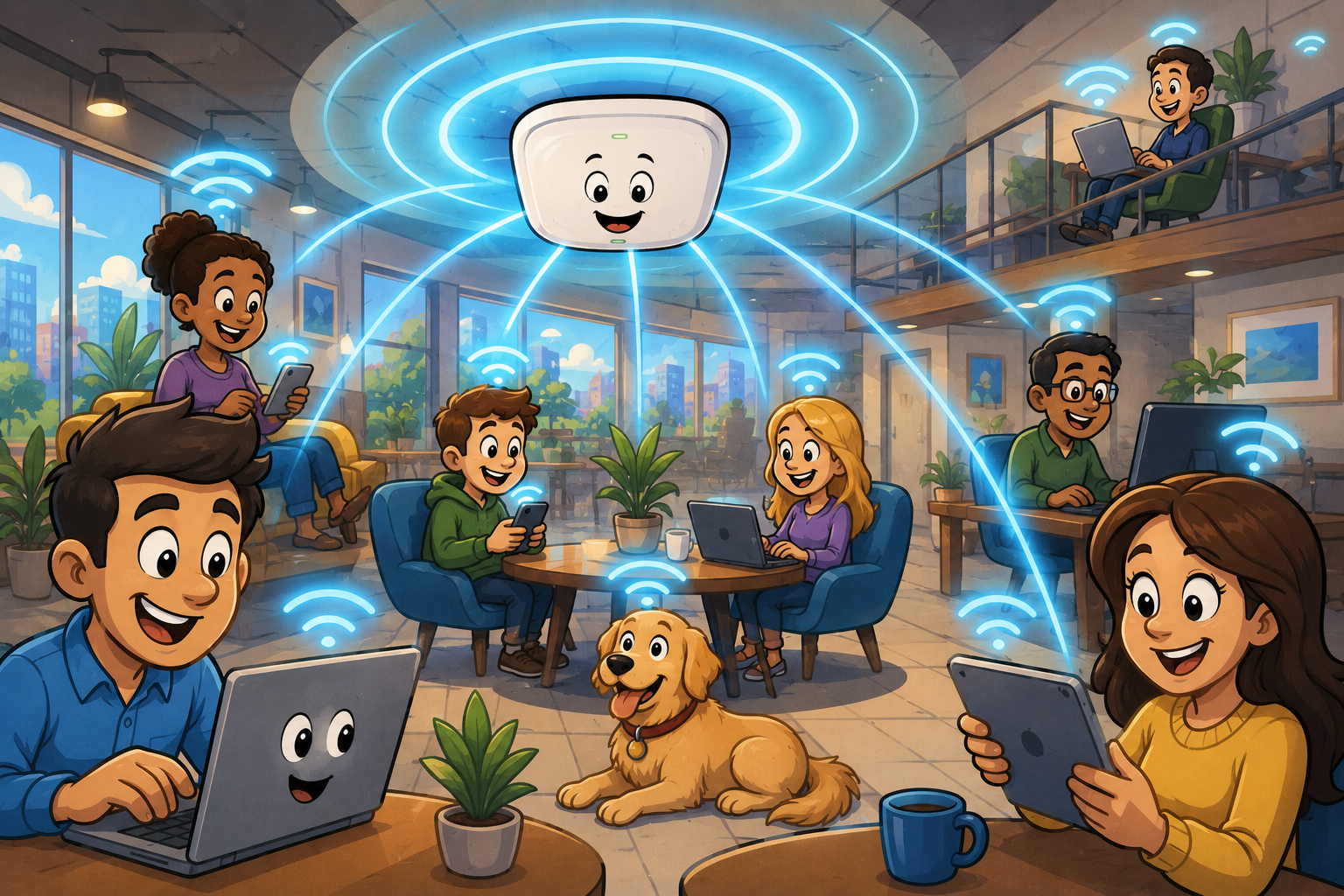
Wi-Fi is a conversation, not a broadcast.
A well-designed wireless network isn't built by making every AP shout as loudly as possible. It's built by carefully controlling coverage, minimizing interference, encouraging efficient roaming, and maintaining balanced communication between clients and infrastructure.
The next time someone suggests solving a Wi-Fi problem by simply turning up the power, remember this: if transmit power alone solved Wi-Fi challenges, every wireless engineer would carry only one tool.
Fortunately (or unfortunately, depending on your perspective) the profession remains considerably more interesting than that!
===
===
Learn More
If you want to learn more about our instructor-led IT training options, visit our training portfolio page here
===
#ITCareers #Certification #Networking #CyberSecurity #CareerDevelopment #ProfessionalDevelopment
===
About NC-Expert
NC-Expert is a privately-held California corporation and is well established within the Wireless, Security, and CyberSecurity industry certification training, courseware development, and consulting markets.
NC-Expert has won numerous private contracts with Fortune level companies around the world. These customers have depended on NC-Expert to train, advise, and mentor their staff.
So remember, if you are looking for the best IT training just call us at (855) 941-2121 or contact us
NC-Expert Blog