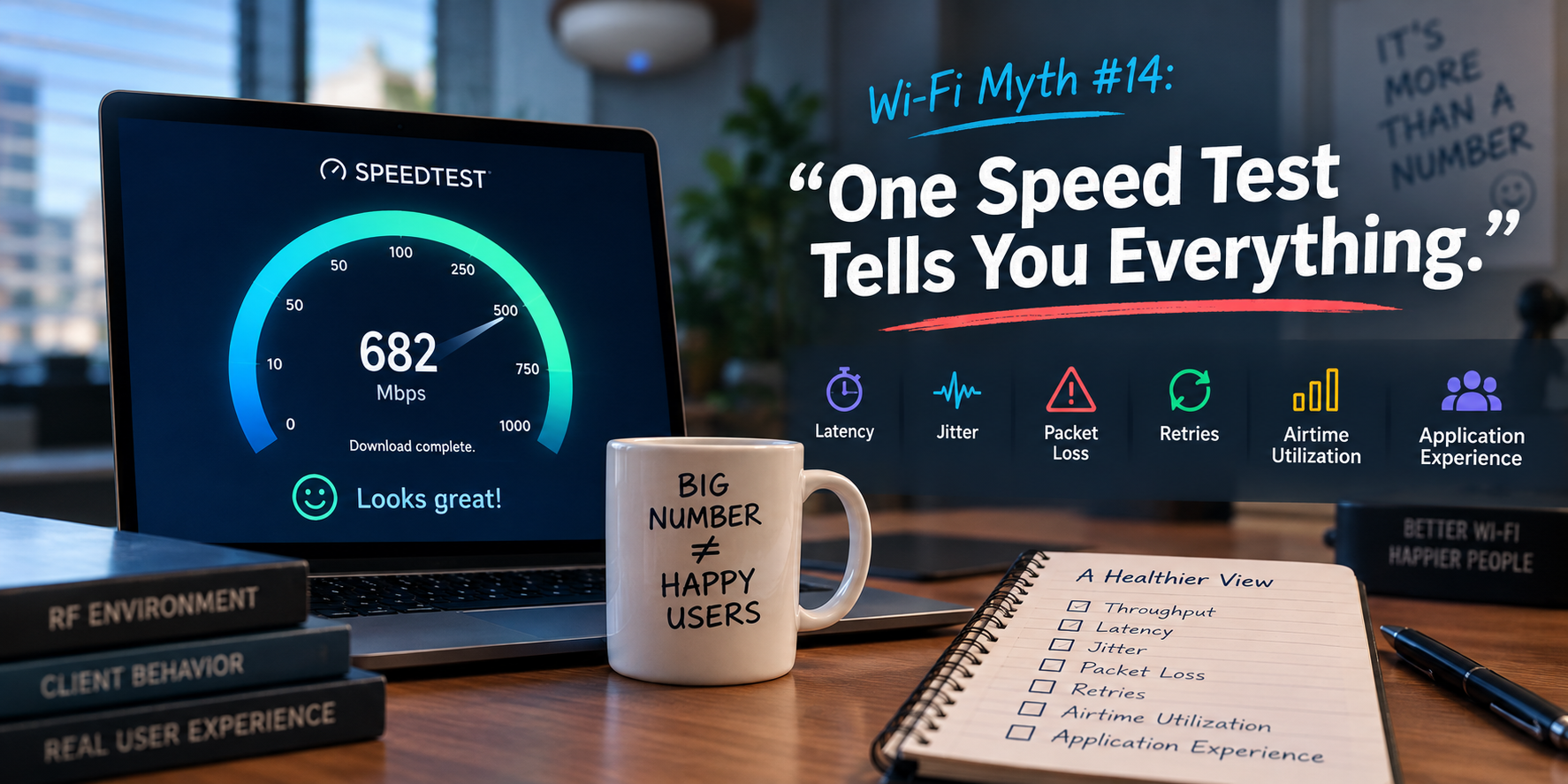
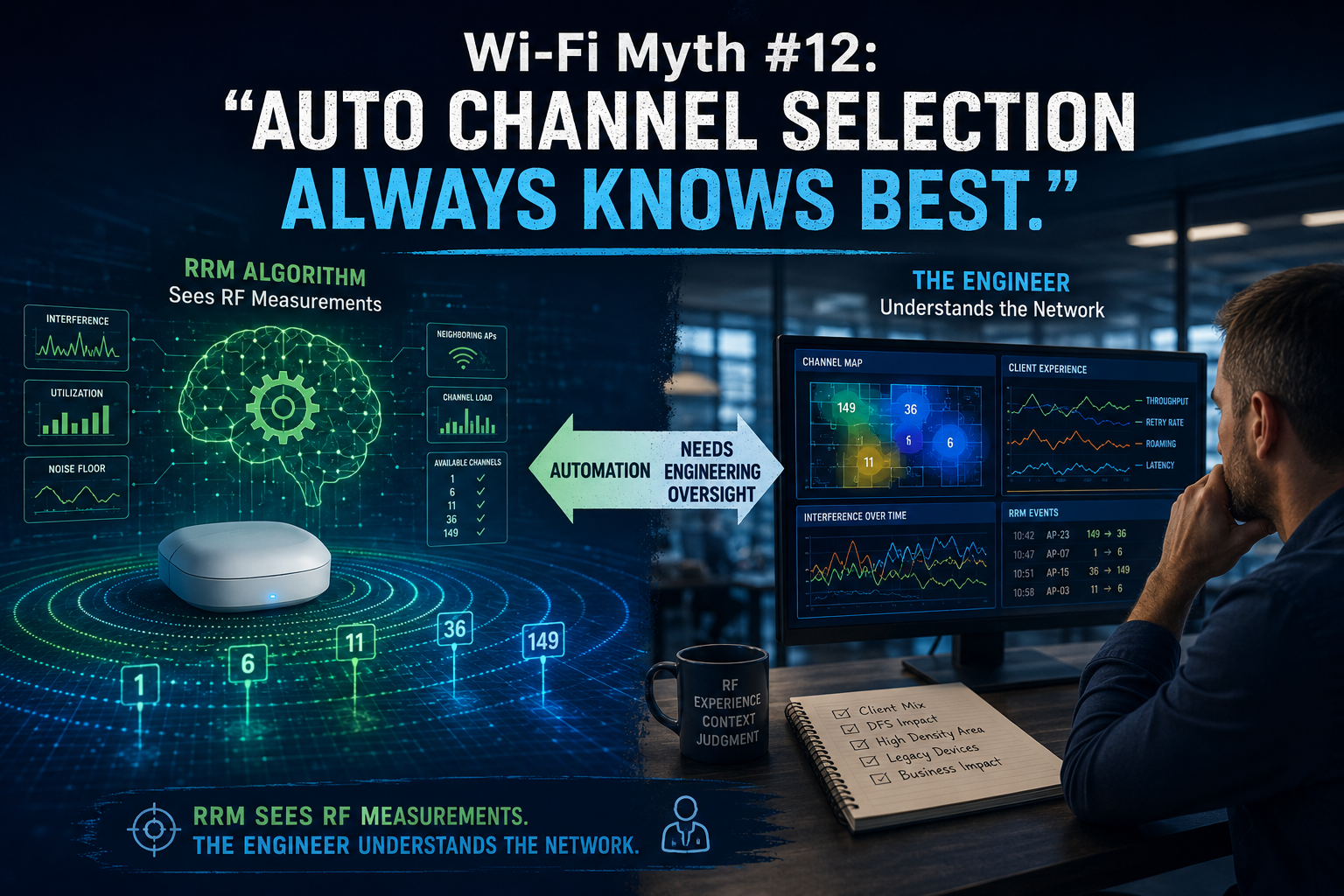
Wi-Fi Myth Series – Myth #9: More Bandwidth Always Means Better Performance
If there's one thing network users love, it's bandwidth.
- Need faster Wi-Fi? More bandwidth.
- Application running slowly? More bandwidth.
- Video buffering? More bandwidth.
- Someone sneezed near the wireless network? Probably needs more bandwidth. :)
As Wi-Fi engineers, we've all heard it. Somewhere along the way, bandwidth became synonymous with performance. But while bandwidth certainly matters, it's only one ingredient in a much larger recipe.
In many deployments, increasing available bandwidth produces little improvement and, in some cases, it can actually make things worse!
Like many Wi-Fi myths, this one contains just enough truth to be convincing. Let's bust it...
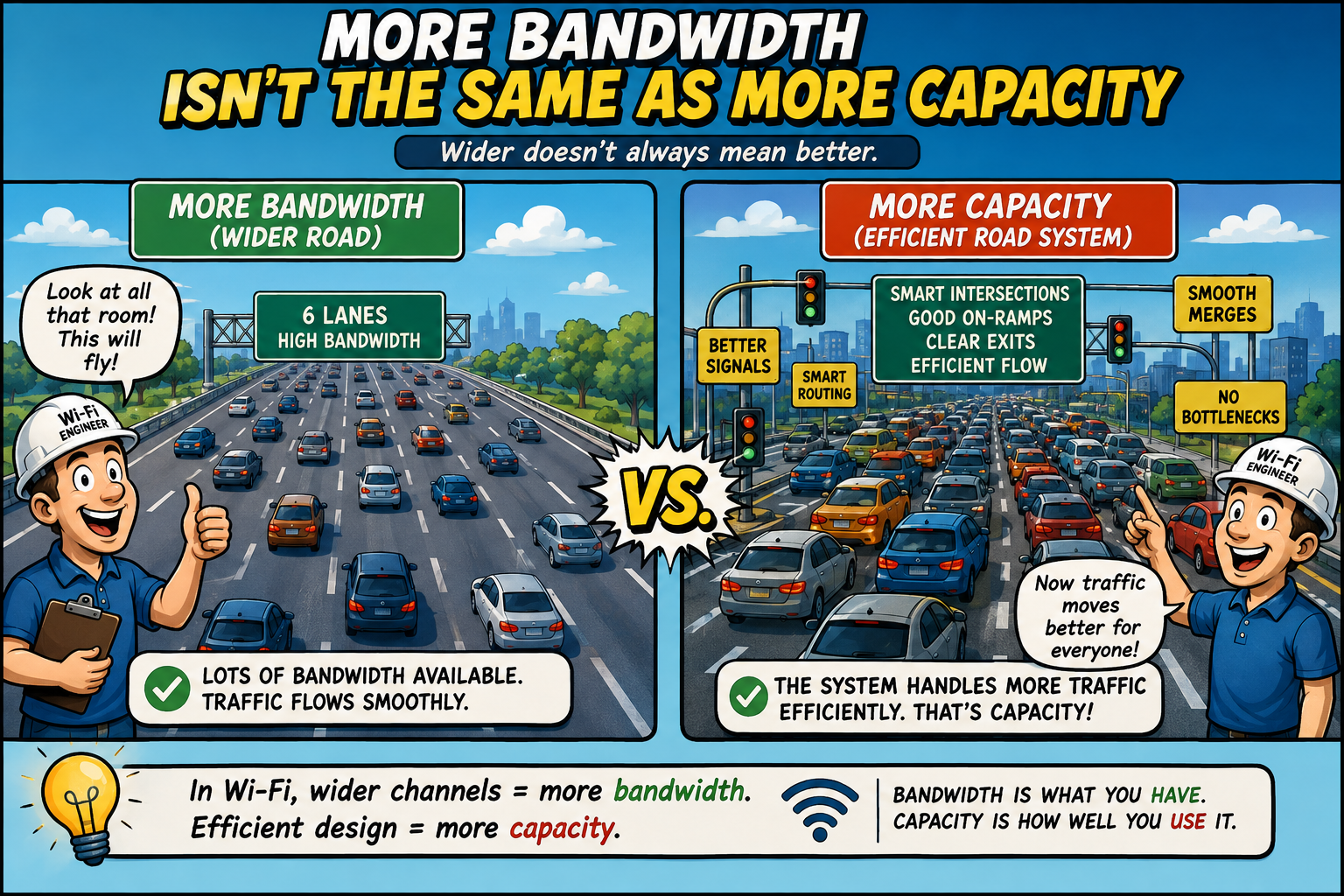
More Bandwidth Isn't the Same as More Capacity
The first misunderstanding comes from confusing throughput with capacity.
Bandwidth describes the amount of data that can be transmitted under ideal conditions.
Capacity describes how many users can successfully share the available airtime.
These are very different things.
Imagine replacing a two-lane country road with a six-lane highway. If only five cars use it each day, nobody notices much difference. But, if you build the highway into the middle of a busy city without improving the intersections, traffic lights, or exits, congestion quickly returns. The road became wider, but the bottlenecks simply moved elsewhere. Wi-Fi behaves much the same way.
A wider channel allows higher theoretical data rates, but it doesn't magically increase airtime efficiency, reduce contention, or eliminate interference.
Sometimes, all you’ve done is to simply build a larger roadway leading to the same traffic jam.
The Air Is Still Shared
Unlike a switched Ethernet network, Wi-Fi isn't point-to-point. Every client connected to an AP shares the same radio medium. Only one device can successfully transmit on a channel at a given moment. This is true whether the channel is 20 MHz or 160 MHz.
As client counts increase, contention becomes the limiting factor, not raw bandwidth. Adding more available throughput doesn't allow multiple clients to talk simultaneously on the same channel. Everyone still politely waits their turn (well... as politely as CSMA/CA allows).
Engineers often focus on PHY rates because they're easy to measure. Users, however, experience airtime.
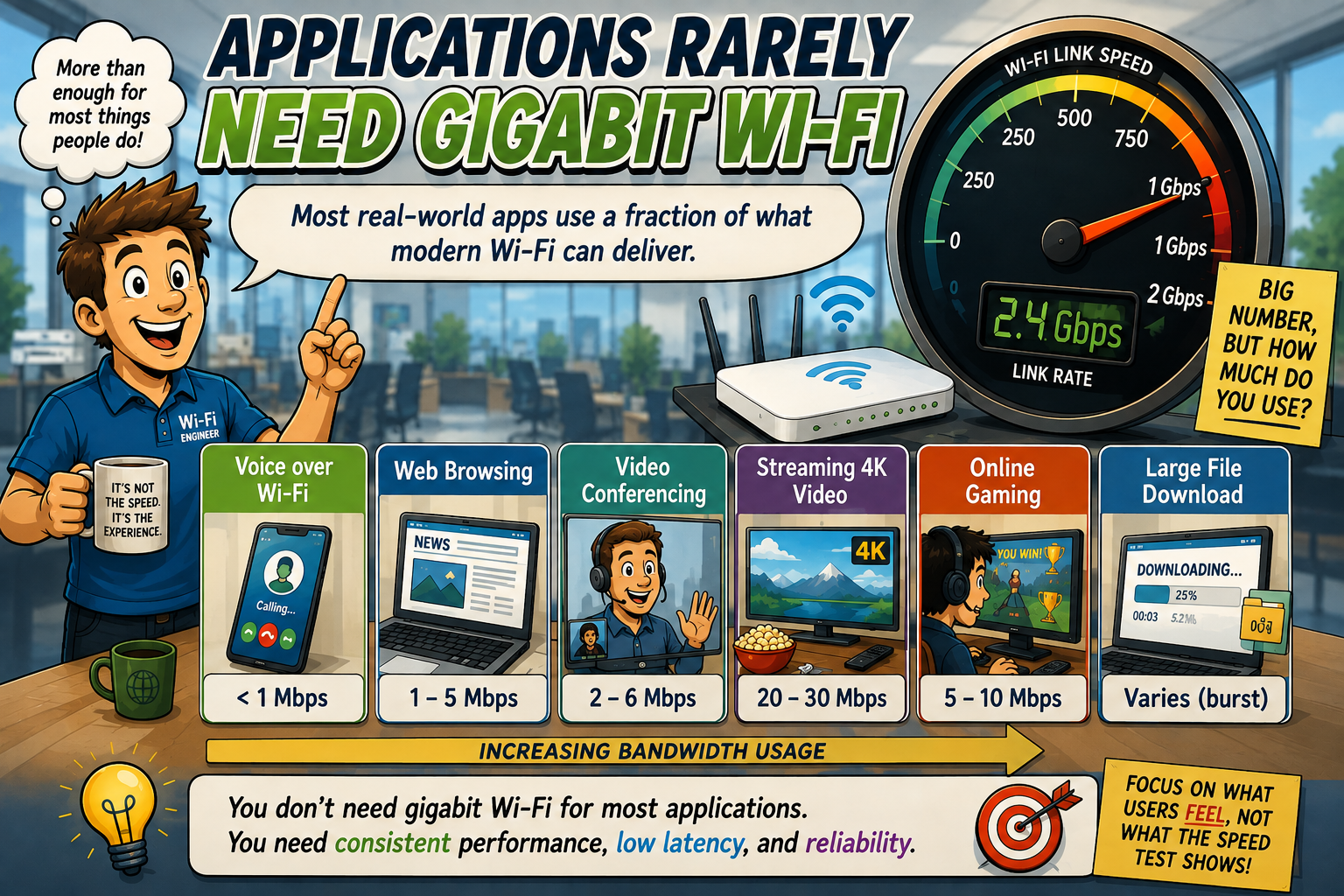
Applications Rarely Need Gigabit Wi-Fi
Here's an uncomfortable truth: most applications don't require enormous throughput. In fact, most requirements are surprisingly modest:
- Web browsing often uses only a few megabits per second.
- Video conferencing usually consumes between 2 and 6 Mbps.
- Streaming 4K video might need 20 - 30 Mbps.
- Voice traffic uses well under 1 Mbps.
Modern Wi-Fi often advertises link speeds exceeding a gigabit. The mismatch is obvious: if an application only needs 5 Mbps, increasing available bandwidth from 600 Mbps to 1.2 Gbps doesn't suddenly make, for instance, Teams meetings twice as productive.
Users notice latency, consistency, roaming quality, and packet loss far sooner than they notice another several hundred megabits of unused capacity.
Faster Links Don't Eliminate Poor RF Design
One of the most common mistakes in enterprise deployments is attempting to solve RF problems with faster technology.
- Poor coverage? Upgrade to Wi-Fi 7.
- Interference? Increase channel width.
- Congestion? Advertise higher data rates.
Unfortunately, radios refuse to read marketing brochures!
If clients experience poor signal quality, excessive retries, hidden nodes, or co-channel interference, increasing theoretical bandwidth changes very little. It's rather like installing a bigger engine into a car with flat tires. The speedometer may look impressive. The journey won't improve very much.
Good RF design still wins... every time.
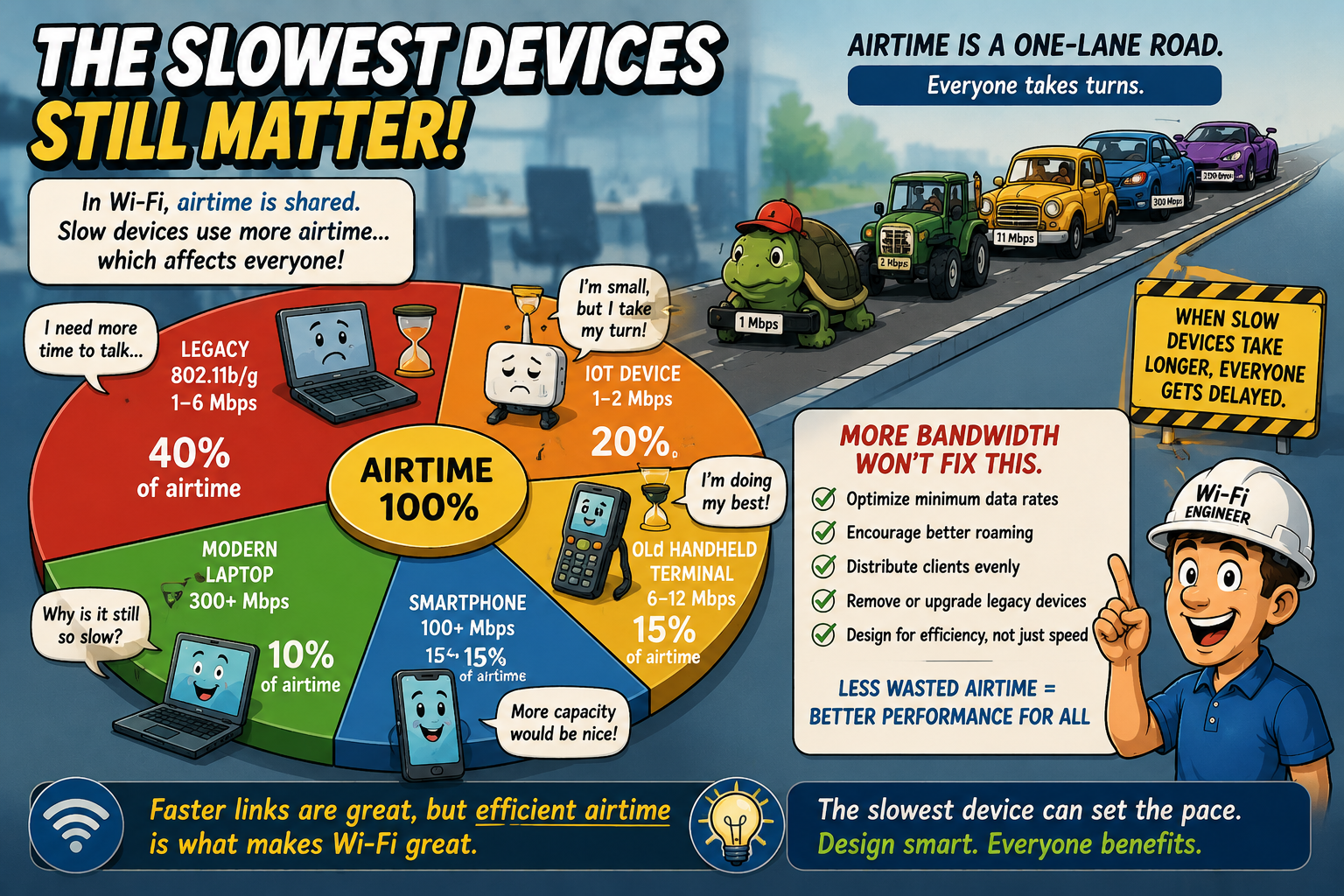
The Slowest Devices Still Matter
Wi-Fi networks are wonderfully democratic but, unfortunately, that means slower clients get their share of airtime too:
- legacy devices,
- distant clients,
- IoT sensors,
- barcode scanners, and
- older handheld terminals
...all compete alongside the newest flagship laptops.
These slower clients often transmit at significantly lower data rates, occupying the channel for longer periods. This extra airtime usage affects everyone.
Adding more available bandwidth doesn't change this fundamental behavior. In fact, many enterprise environments see greater improvements by:
- optimizing minimum data rates,
- improving client distribution, and
- encouraging better roaming
...than by simply increasing available throughput. Sometimes less airtime is far more valuable than more bandwidth!
Bottlenecks Usually Live Somewhere Else
Wi-Fi is only one section of the end-to-end path. Even a perfect wireless link eventually hands traffic to:
- internet connections
- firewalls
- WAN links
- authentication servers
- application servers
- cloud services
- storage systems
If any of these become constrained, increasing wireless bandwidth produces no measurable benefit. It's similar to replacing every hallway in an office building with moving walkways, only to discover everyone is still waiting for a single elevator. The bottleneck simply moved.
Experienced engineers troubleshoot the entire path... not just the wireless portion.
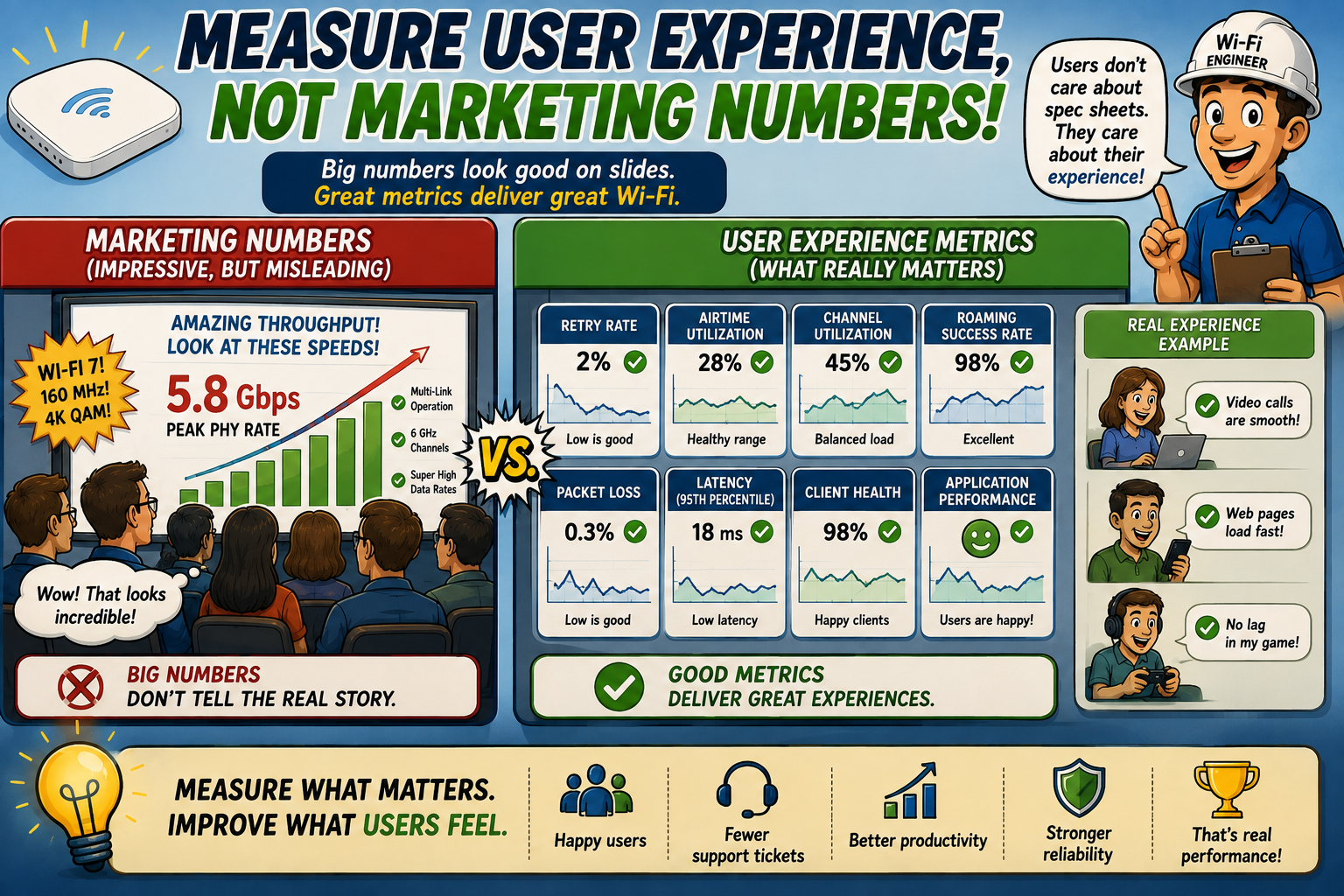
Measure User Experience, Not Marketing Numbers
Modern controllers provide enormous amounts of telemetry. It’s there for you, so use it.
Instead of celebrating ever-higher PHY rates, focus on metrics that actually reflect user experience:
- retry percentages
- airtime utilization
- channel utilization
- roaming success rates
- packet loss
- latency
- application performance
- client health
- RF interference
These measurements can reveal problems that higher bandwidth alone can never solve. Users don't care whether their laptop negotiated 2.8 Gbps. They care whether the meeting freezes when they're presenting to the executive team!
One of these generates excitement in marketing presentations. The other generates help desk tickets. Guess which one engineers spend more time dealing with?!
Busting the Myth
Myth: More Bandwidth Always Means Better Performance
More bandwidth certainly has its place. Higher throughput enables demanding applications, improves large file transfers, and supports evolving technologies.
Modern Wi-Fi standards continue to deliver remarkable performance improvements, but bandwidth is only one piece of the engineering puzzle.
Reliable Wi-Fi comes from thoughtful RF design, efficient airtime management, sensible channel planning, healthy client behavior, careful capacity design, and end-to-end performance optimization.
The best Wi-Fi engineers understand that success isn't measured by the biggest number on a specification sheet – instead, it's measured by users who simply stop thinking about the network because everything “just works”. That's the real performance metric!
And that's why this myth deserves to be firmly - and permanently - busted!
Myth = Busted!
===
===
Learn More
If you want to learn more about our instructor-led IT training options, visit our training portfolio page here
===
#ITCareers #Certification #Networking #CyberSecurity #CareerDevelopment #ProfessionalDevelopment
===
About NC-Expert
NC-Expert is a privately-held California corporation and is well established within the Wireless, Security, and CyberSecurity industry certification training, courseware development, and consulting markets.
NC-Expert has won numerous private contracts with Fortune level companies around the world. These customers have depended on NC-Expert to train, advise, and mentor their staff.
So remember, if you are looking for the best IT training just call us at (855) 941-2121 or contact us
NC-Expert Blog